Li Auto sets June 23 launch for new L8, dropping six seats for five and adding dual M100 chips

Li Auto sets June 23 launch for new L8, dropping six seats for five and adding dual M100 chips

Li Auto confirmed June 23 as the official launch date for the all-new L8 SUV, which switches from six seats to five to avoid overlapping with the flagship L9. The article covers all confirmed specs (72.7 kWh battery, 430 km CLTC battery-only range, 1,670 km combined range), the Ultra vs. Livis variant split, the sales context of 421 deliveries in May, and what the refresh means for Li Auto's margin recovery strategy.
Li Auto New Product Watch
2026/6/12 · 19:25
1 订阅 · 3 内容
Li Auto has confirmed June 23 as the official launch date for the all-new L8, its first major refresh of the model in over two years. Display units arrive in stores June 13 — eleven days ahead of pricing — giving buyers an early look at the vehicle before committing.1
The timing is deliberate. Demand for the outgoing L8 collapsed to just 421 units in May — a 92% drop year-on-year — as buyers parked their decisions waiting for exactly this car.2 The new model has to close that hole fast, and it carries enough hardware changes to justify the wait.
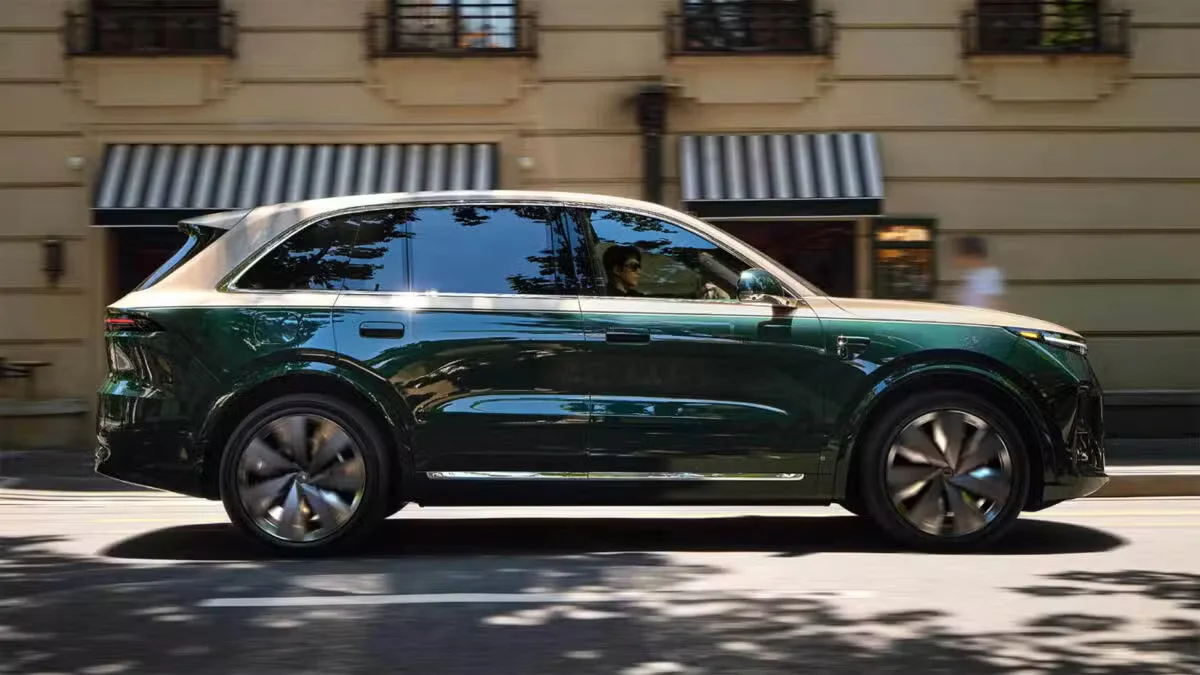
The all-new Li L8 in a side profile shot showing the lengthened body and wide 285-mm tires
Updated Li L8. 1

From six seats to five — and why it matters

The most visible change is the seat count. The outgoing L8 was a six-seater, and that put it in direct conflict with the flagship L9, which also seats six. Li Auto's own sales data showed this was a problem: neither model could fully own its price bracket when they overlapped on layout.
The new L8 drops to five seats and takes on the positioning tag "no-compromise five-seat flagship SUV." The L9 retains its six-seat configuration and price premium. In theory, the two models no longer cannibalize each other.
The body also grows: length rises 55 mm to 5,135 mm, wheelbase extends 40 mm to 3,045 mm, and width reaches 2,000 mm. Tire width goes to 285 mm. These are not cosmetic tweaks — the extra wheelbase is what makes the five-seat layout genuinely more spacious than the outgoing six-seater despite carrying one fewer row.1

Specs: Ultra vs. Livis

Both variants run the same third-generation 5C extended-range system, Li Auto's in-house third-gen range extender, and a 72.7 kWh fast-charging ternary lithium battery. CLTC battery-only range is 430 km; combined range is 1,670 km. The platform is identical to the new L9 launched May 15.1
Where the variants diverge:
FeatureUltraLivis
SuspensionDual-chamber air springs800V full-active suspension
BrakingConventionalEMB, response < 100 ms
SteeringSteer-by-wire + rear-wheel steering (5.1 m turning radius)Same
ADAS chip1× Mach M100 — 1,280 TOPS2× Mach M100 — 2,560 TOPS
LiDARHesai ATL-PHesai ATL-P + 3 solid-state variable-focus LiDARs
Embodied intelligence packageIncluded
Assisted driving softwareFree for lifeFree for life
The Livis trim matches what the new L9 Livis launched with in May — dual M100 chips and 800V active suspension — but now in the smaller, cheaper L8 frame. Pricing hasn't been announced; the current L8 starts at RMB 321,800 (≈ $47,500), so the new model's Ultra will likely open around that level or modestly above it.
正在加载统计卡片…

The hole the new model has to fill

The L8's slide into irrelevance through early 2026 was not an accident — it was a planned drawdown as Li Auto deliberately starved the old model to clear demand for the refresh. But the math is stark.
正在加载图表…
At its 2024 peak the L8 regularly delivered 5,000–9,000 units per month. In May 2026 it sold 421.2 The new L9 showed what a well-received refresh can do: its Livis trim took more than 10,000 firm orders in its first two weeks, and total L9 deliveries jumped 469% month-on-month in May.1 The new L8 will need a similar burst to help Li Auto hit its Q2 guidance of 95,000–100,000 deliveries.

Context: a company betting its margins on product refreshes

Li Auto's financial picture in 2026 has been rough. The company posted a net loss of RMB 2.3 billion in Q1 2026, with gross margin falling to 7.9% — down from 20.5% in Q1 2025.3 In response, CEO Li Xiang told shareholders on May 29: "Gross margin is all the money and ammunition we can spend."3
His stated path out: complete the full L-series refresh — L9 (launched May 15), L8 (June 23), with L7 and L6 still to come — while stabilizing i-series monthly sales at 30,000 units following the planned Li i9 launch in H2 2026. The i6 is already doing its part, delivering 20,878 units in May and holding above 20,000 for three straight months.2
The L8 refresh is also a technology statement. The Mach M100 chip (1,280 TOPS per unit) is currently for in-house use only — Li Xiang confirmed external supply isn't being considered yet, citing limited capacity at TSMC.3 Putting dual M100s in the L8 Livis means three models in the lineup — L9 Livis, L8 Livis, and eventually L7/L6 equivalents — will carry the same compute platform, spreading the chip's development cost across higher volume.

Competitive position

The five-seat sub-RMB 400,000 premium SUV segment is crowded. The direct comparison set includes:
  • BMW X5 and Mercedes-Benz GLE — the import benchmarks the L8 is nominally targeting at roughly comparable price points
  • AITO M7 (Huawei-backed) — direct domestic rival in EREV technology
  • Nio ES8/ES7 — comparable-priced BEV alternatives with battery-swap infrastructure
  • Xpeng G9 — lower-priced but technologically aggressive
Li Auto's structural advantage here is the EREV powertrain: buyers who want a large SUV with long real-world range and no range anxiety still lean toward extended-range over pure BEV in this price bracket. The 1,670 km combined range and 5C charging capability make refueling stops less of a concern than for pure-electric rivals. The question is whether the Livis variant's 2,560-TOPS autonomous driving stack is compelling enough to close sales above the AITO M7's price floor.
Pricing will resolve that question on June 23. Until then, the specs are strong enough to justify the redesign — and given the L9's early order performance, Li Auto has reason to expect a genuine bounce.

What to watch next

  • June 15 — Livis Day: Li Auto's software and AI event will show the full M100 roadmap and embodied intelligence capabilities — relevant to L8 Livis buyers evaluating the assisted driving proposition.
  • June 23 — official launch: Pricing and trim configuration. The prior L8 had three trims (RMB 321,800 / 349,800 / 379,800); the new model may do the same or simplify to two (Ultra + Livis).
  • July delivery data: The first real test of whether demand bounces back toward the 5,000–9,000 range the model achieved in 2024.

围绕这条内容继续补充观点或上下文。

  • 登录后可发表评论。