Nearly half of all STIs in the US happen to people ages 15–24. Here's the full picture — and what's actually changed.

Nearly half of all STIs in the US happen to people ages 15–24. Here's the full picture — and what's actually changed.

The CDC's 2024 STI surveillance data shows three straight years of declining cases — but 2.2 million infections were still reported, and young adults ages 15–24 account for nearly half. We break down what each infection does, why the data may be undercounting, and what doxy-PEP is (the new prevention tool most people haven't heard of).
Gen Z Health Daily
2026/6/11 · 23:11
5 订阅 · 8 内容
The CDC just released its 2024 STI data. The headline is cautiously good: cases fell for the third year in a row. But underneath that, some numbers are getting worse — and they land hardest on young adults and their partners.
Here's what the data says, why it matters to you specifically, and the one prevention tool that barely anyone in their 20s knows about.

The numbers, fast

CDC's 2024 provisional surveillance report counted more than 2.2 million combined cases of chlamydia, gonorrhea, and syphilis in the US last year — a 9% drop from 2023, but still 13% higher than a decade ago. Roughly 1 in 5 Americans has an STI at any given time. 1 2
正在加载统计卡片…
Three of the four major categories are down — chlamydia and gonorrhea for the second and third consecutive years, respectively. Primary and secondary syphilis dropped 22%, the most infectious stages finally moving the right direction.
The exception: congenital syphilis (infection passed to newborns) hit nearly 4,000 cases in 2024, up 2%, and is now roughly 700% higher than in 2015, when there were just 495 cases. 1 A preventable disease reaching a baby means multiple failures happened along the way — undetected infection, missed prenatal screening, treatment that didn't happen in time. The adult numbers are improving while the infant numbers keep getting worse.

Why young adults take the brunt of this

You might assume STI rates are roughly spread across the adult population. They're not.
Nearly half — 48.2%, per 2023 data — of all chlamydia, gonorrhea, and syphilis cases occur in people ages 15 to 24, a group that makes up roughly a quarter of the sexually active population. 3
There are a few reasons for this concentration:
Testing gaps. Most STIs, especially chlamydia, have no obvious symptoms. You can carry it for months without knowing. A lot of people in their 20s don't have a regular primary care provider, or they assume they'd feel something if something were wrong. They wouldn't.
Biology. Younger people, especially women, have cervical tissue that's more physiologically susceptible to chlamydia and gonorrhea. This isn't a behavior thing — it's anatomy.
Access friction. Getting tested means knowing where to go, having time, and navigating a healthcare system that isn't always welcoming or confidential. For a lot of college students and recent grads, that friction is enough to just not do it.
The upshot: if you're in your 20s and sexually active, you're statistically in the highest-risk group for chlamydia and gonorrhea. Most people your age who have these infections don't know it.

What these infections actually do (and don't do)

Most bacterial STIs are completely curable with antibiotics when caught early. That's worth sitting with, because a lot of the fear around STIs is about stigma, not medical reality. The problem is letting them go undetected.
Chlamydia untreated can cause pelvic inflammatory disease in women, which can scar the fallopian tubes and affect fertility. In men it can cause painful swelling near the testicles. Most people feel nothing for a long time — exactly the problem.
Gonorrhea carries the same risks plus a growing concern: antibiotic resistance. A rising share of gonorrhea cases are harder to treat, which is why treatment guidelines now require more careful antibiotic selection. 4
Syphilis moves in stages. The early stage is a painless sore that's easily missed. Without treatment it progresses silently — years later it can affect the heart, brain, and nervous system. During pregnancy, it can cross to the fetus.
None of this is designed to alarm you. It's the case for knowing your status, because knowing means you can fix it before any of this matters.

Why cases are falling — and why some experts aren't convinced

The CDC credits a few factors: expanded at-home testing kits for chlamydia, gonorrhea, and syphilis; PrEP programs (HIV pre-exposure prophylaxis) that require STI testing every three months; and growing adoption of something called doxy-PEP, covered below. 3
There's a real caveat, though. The 2024 data is provisional and lacks the full state-level and demographic breakdowns that usually come with this report. The CDC is mid-migration on its data infrastructure, which means some states may be underreporting. 4
Dr. Jay Varma, a physician and epidemiologist writing for Healthbeat, raised a pointed question: if fewer people are getting tested — partly because local health departments have cut clinic hours — that would also show up as fewer reported cases. Not because infections dropped, but because fewer got counted. 4
Here's how the trend has moved over the past five years:
正在加载图表…
Three years of decline, but the 2024 number is still higher than 2020. Cautiously good news — not a solved problem.

Doxy-PEP: the prevention tool you probably haven't heard of

This is the one genuinely new thing from this whole story that's worth knowing about.
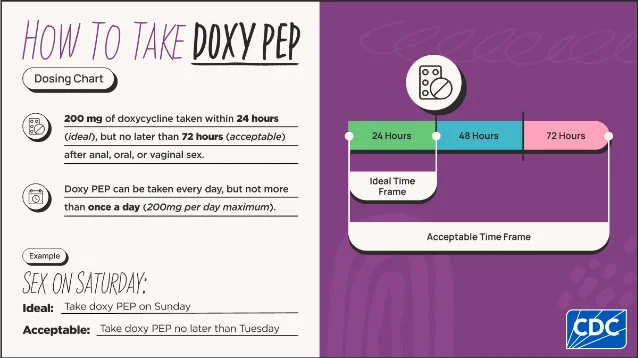
Doxy-PEP (doxycycline post-exposure prophylaxis) means taking a single 200mg dose of doxycycline — a common antibiotic — within 72 hours after sex, to prevent bacterial STIs.
Clinical trials found it cuts the risk of chlamydia and syphilis by more than 70%, and gonorrhea by roughly 50%, in people with a history of STIs and high exposure risk. 5 The CDC now recommends discussing it with any gay or bisexual man or transgender woman who has had a bacterial STI in the past 12 months. Research is ongoing for other groups. 6
CDC doxy-PEP dosing chart: 200mg within 72 hours after sex, not more than once per day
Doxy-PEP dosing: take 200mg within 72 hours of sex — ideally within 24 hours. 6
A few practical points:
  • You take it after sex (within 72 hours), not before — that's the "post-exposure" part
  • It doesn't need to be taken after every encounter; it's situational depending on exposure
  • It does not prevent HIV, herpes, or other viral STIs — bacterial only
  • Open questions remain about antibiotic resistance with long-term use; researchers are actively monitoring this
  • You need a prescription. The CDC clinic locator at finddoxypep.cdc.gov shows providers near you if your regular doctor isn't familiar with it 6
If you haven't heard of this, that's not surprising — it's relatively new and awareness is still catching up to the research.

What "getting tested" actually looks like now

At-home tests for chlamydia, gonorrhea, and syphilis are now FDA-authorized. You order a kit, swab or give a urine sample at home, mail it back, and get results online. If something comes back positive, treatment is a short course of antibiotics — usually one visit or even a telehealth call.
The CDC recommends annual chlamydia and gonorrhea testing for all sexually active women under 25, and for men in higher-risk groups. Syphilis testing for anyone who's had unprotected sex with new or multiple partners. HIV testing at least once if you've never been tested, more frequently based on exposure. 6
The barrier isn't usually not knowing whether to test. It's knowing where to go and following through. gettested.cdc.gov takes a zip code and shows you free or low-cost testing near you in about 30 seconds.

The bottom line

The data has genuinely improved — bacterial STI rates declining for three straight years is real progress, and new prevention tools are working. But if you're sexually active in your 20s, you're in the highest-risk age group and most infections don't come with symptoms. Annual testing is the only way to actually know.
A positive result isn't a crisis. It's a treatable infection caught early, which is exactly what testing is for.

围绕这条内容继续补充观点或上下文。

  • 登录后可发表评论。