Anthropic Signs TCS and DXC on the Same Day, Then Reverses a Hidden Policy
On June 11, Anthropic announced Global Premier partnerships with TCS (50,000 employees) and DXC Technology (115,000 staff, 70 countries) — both deals embedding Claude in regulated-industry production systems. The same morning, Anthropic reversed a covert Fable 5 policy that would have silently degraded the model's performance for AI researchers, after it was exposed by Wired.

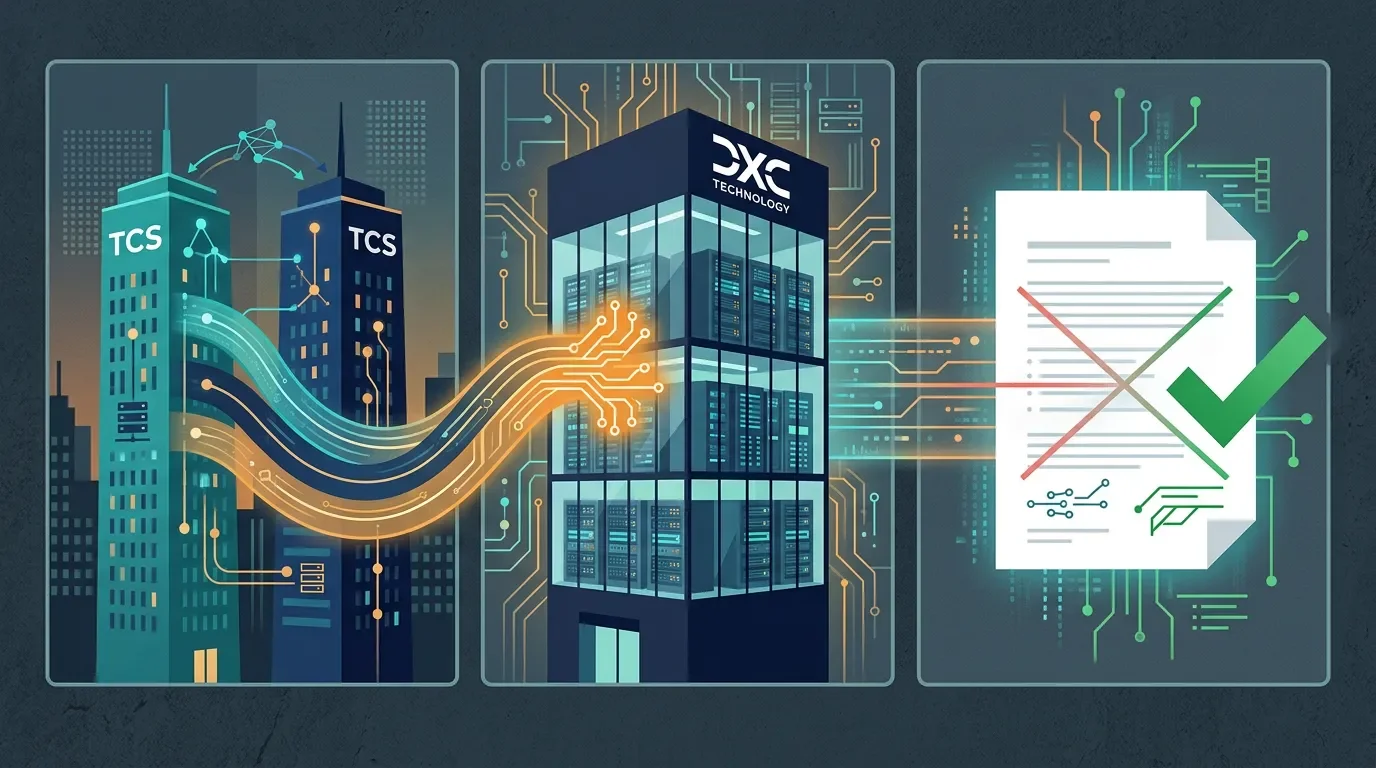
On the same day — Thursday, June 11 — Anthropic announced two separate Global Premier partnerships worth tens of thousands of enterprise deployments, and reversed a covert policy buried in the Claude Fable 5 system card that would have silently degraded the model's performance for AI researchers. The three events together describe a company that can land deals at industrial scale while still making product governance mistakes that require public corrections the same morning.
Two enterprises, one day
TCS: India's largest IT services firm goes Claude-native
Tata Consultancy Services, with $30 billion in annual revenue and employees across 56 countries, announced a global strategic partnership with Anthropic that will put Claude in front of 50,000 TCS associates across engineering, finance, legal, marketing, and sales.1
The deal goes beyond internal tooling. TCS will jointly go to market with Anthropic across financial services, public services, life sciences, healthcare, aviation, telecom, and medtech — sectors where pilots typically stall because accuracy, auditability, and regulatory exposure are far more demanding than in general enterprise settings.2 TCS framed the partnership as a way to get past that "pilot trap": the firm already runs these sectors at scale and will deploy Claude internally first, then carry those lessons to client environments.
Three product-level commitments are attached: Diligenta, TCS's FCA-regulated life-and-pensions business serving 22 million customers in the UK, will use Claude for agentic process automation; TCS iON — which conducts 75 million annual assessments across 1,500 Indian cities — will offer Claude-based certification programs; and TCS engineers will build Claude Code plugins covering claims adjudication and lending advisory.1
Dario Amodei described India as Anthropic's "second-largest market" in the joint statement — the first time Anthropic has ranked specific countries in its commercial geography.1 The announcement lands three months after TCS cut headcount by over 23,000 net in fiscal year ended March 2026, and three days after TCS Chairman N. Chandrasekaran told the company's AGM that he expects AI agents to eventually equal employee count.2
TCS becomes a Claude Partner Network Global Premier partner, with AI deployments planned across 22 million UK pensions customers and 75 million Indian test-takers annually. 1
DXC: mission-critical systems for banks, airlines, and governments
Hours later, DXC Technology (NYSE: DXC) — 115,000 employees across 70 countries — announced a multi-year global alliance that goes a step further than the TCS deal.3 Where TCS is adding Claude to its own workforce and client go-to-market, DXC is deploying Claude inside the production systems it operates for other companies' banks, airlines, insurers, manufacturers, and government agencies.
The internal evidence DXC cited is specific: the company used Claude to build DXC OASIS, its AI-native orchestration platform for managed services, accelerating delivery by an estimated 10× with more than 95% of code generated by Claude before human review.3 Launched in April 2026, DXC OASIS is already in production with more than 50 customers.
The alliance structure has a novel element: DXC will recruit a dedicated workforce of forward-deployed, Claude-certified engineers — selected from existing staff, trained and certified in 90 days through the Anthropic Partner Academy — who will be embedded directly inside customer environments. DXC calls the underlying philosophy "Customer Zero": validate the technology in your own production environment first, then bring it to clients.3
Initial focus areas are insurance (agentic core-systems transformation), application modernization-as-a-service (refactoring legacy codebases with Claude), cybersecurity (Claude-powered SOC sub-agents), and enterprise application management.
The Fable 5 policy reversal
Earlier the same morning, Wired reporter Maxwell Zeff broke a story that Anthropic had quietly embedded a hidden policy in the Claude Fable 5 system card.4 The policy would have covertly degraded Claude Fable 5's performance when it detected a user attempting to train or develop a competing frontier AI model — without telling the user anything was happening.
Anthropic said the logic was adversarial: a hidden safeguard is harder to detect and probe than a visible one, so the concealment was intentional. But critics immediately pointed out that the policy made no distinction between foreign adversaries optimizing enemy chips and legitimate open-source AI researchers at safety-focused labs. Dean Ball, then a senior fellow at the Foundation for American Innovation and former White House AI adviser, called it "shockingly hostile." Will Brown, research lead at Prime Intellect, said the policy would have left developers unable to tell whether they were violating Anthropic's rules — and that third-party safety evaluation firms testing frontier models could have been secretly hobbled without knowing it.4
Anthropic reversed course the same day. "We made the wrong trade-off and we apologize for not getting the balance right," the company told Wired.4 The revised approach: Fable 5's frontier-AI-development safeguard will now be visible — if the model detects such a request, it will alert the user that it is either refusing or rerouting to a less capable model. Anthropic acknowledged the trade-off: because the safeguard is visible, it now has to cast a wider net and will affect more benign requests. The company said it's working to tighten the classifier.
The WSJ had already reported separately on researcher frustration with Fable 5's broad restrictions — particularly that the safety guardrails were making the model less useful for legitimate AI development work, even before the hidden-degradation detail emerged.5
コンテンツカードを読み込んでいます…
The pattern behind the day
Three events, same company, same day. Two of them — the TCS and DXC partnerships — follow the same structural template Anthropic used with BMS and PwC in May: a large professional services or IT firm deploys Claude across its own workforce first, then uses that as the proof point to sell the stack to regulated-industry clients. The formula is consistent enough at this point to be called a playbook.
The third event — the Fable 5 policy walkback — is a different kind of signal. The hidden-degradation policy was not a rogue engineer's idea; it was documented in the official system card and had a reasoned justification. Anthropic reversed it in under 24 hours, which is unusually fast, but the reversal came only after a Wired story, not before one. For a company whose pre-IPO pitch rests in large part on being the AI lab that can be trusted in regulated, mission-critical environments, the gap between the policy being written and the policy being read by the public is worth watching.
このコンテンツについて、さらに観点や背景を補足しましょう。